LOS Chapter Page
Through research in the Harvard University Archives and in several Harvard libraries, including the Houghton Library and the Radcliffe Institute’s Schlesinger Library on the History of Women in America, as well as in collections of the Massachusetts Historical Society, the Boston Athenaeum, the American Philosophical Society, the University of Michigan Library, and the New York Public Library Schomburg Center for Research in Black Culture, among other repositories, this report documents now incontestable truths: During the 17th and 18th centuries, the sale and trafficking of human beings—in slavery—and the industries rooted in the labor of enslaved women, men, and children were pervasive around the world, comprised a vital part of the New England economy, and powerfully shaped Harvard University. Harvard leaders, faculty, staff, and benefactors enslaved people, some of whom labored at the University; accrued wealth through the slave trade and slave labor; and defended the institution of slavery.
In documenting these truths, this report builds on the groundbreaking work of researchers at Harvard and other universities: In recent years, scholars have documented extensive relationships between American institutions of higher education and slavery. Indeed, a consortium of more than 80 institutions of higher education, called Universities Studying Slavery and based at the University of Virginia, is engaged in this work. We now officially and publicly—and with a steadfast commitment to truth, and to repair—add Harvard University to the long and growing list of American institutions of higher education, located in both the North and in the South, that are entangled with the history of slavery and its legacies.
A Community Reckoning with Slavery and Its Legacies
The findings of this committee—summarized in this introduction and detailed in the pages that follow—not only reveal a chasm between the Harvard of the past and of the present but also point toward the work we must still undertake to live up to our highest ideals. Today, Harvard University enrolls a racially diverse student body champions race-conscious admissions policies in our courts of law; supports “inclusive excellence” employs a faculty that includes renowned scholars of African descent and a celebrated department of African and African American studies hosts a Native American Program that supports Native students and distinguished Native American faculty and embraces reckoning with its past. Yet legacies of slavery persist, and our community, working together, has the opportunity to shape a better future.
Harvard’s 29th president, Lawrence S. Bacow, established the Presidential Initiative on Harvard & the Legacy of Slavery in 2019, appointed a committee representative of all the University’s schools, and charged this group with diving deep into our history and its relationship to the present. President Bacow asked the committee to “give additional dimension to our understanding of the impact of slavery” at Harvard. This work, he said, should “have a strong grounding in rigorous research and critical perspectives” that “will inform … our understanding of facts,” as well as “how we might address the ramifications of what we learn.” President Bacow also asked the committee to “concentrate on connections, impact, and contributions that are specific to our Harvard community” and “provide opportunities to convene academic events, activities, and conversations that will encourage our broader University community to think seriously and rigorously about the continuing impact and legacy of slavery in 2019 and beyond.”
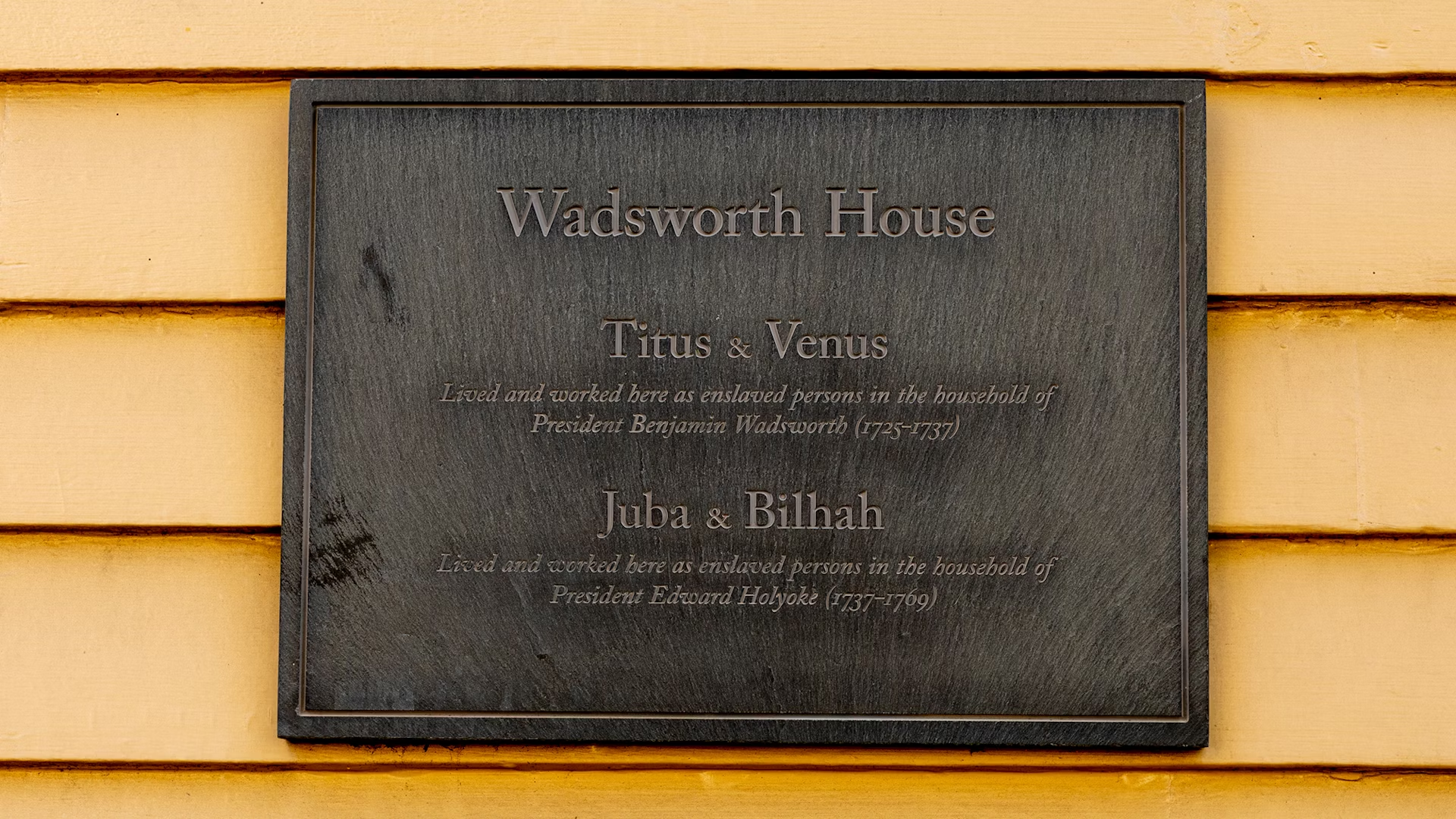
This charge built on earlier work. In 2016, Drew Gilpin Faust, the University’s 28th president, publicly acknowledged that “Harvard was directly complicit in America’s system of racial bondage from the College’s earliest days in the 17th century until slavery in Massachusetts ended in 1783, and Harvard continued to be indirectly involved through extensive financial and other ties to the slave South up to the time of emancipation.” She established a committee on the University and slavery that, with the aid of the researcher Caitlin Galante DeAngelis (PhD 2014), conducted a preliminary investigation upon which this report builds. These initial efforts included, in 2016, a public ceremony in which then-President Faust and the late civil rights leader US Congressman John Lewis unveiled a plaque affixed to Wadsworth House in Harvard Yard that acknowledges the unfree labor of four enslaved people—Titus, Venus, Juba, and Bilhah—who lived there and worked for two Harvard presidents and their families. A 2017 conference at the Radcliffe Institute for Advanced Study, organized at Faust’s suggestion with the support of then–Radcliffe Dean Lizabeth Cohen, brought together prominent thinkers about universities and slavery from around the country.
Our findings are as follows:
- Slavery—of Indigenous and of African people—was an integral part of life in Massachusetts and at Harvard during the colonial era.
- Between the University’s founding in 1636 and the end of slavery in the Commonwealth in 1783, Harvard faculty, staff, and leaders enslaved more than 70 individuals, whose names are listed in Appendix I.
- Some of the enslaved worked and lived on campus, where they cared for Harvard presidents and professors and fed generations of Harvard students.
- Through connections to multiple donors, the University had extensive financial ties to, and profited from, slavery during the 17th, 18th, and 19th centuries.
- These financial ties include donors who accumulated their wealth through slave trading; from the labor of enslaved people on plantations in the Caribbean islands and the American South; from the sale of supplies to such plantations and trade in goods they produced; and from the textile manufacturing industry in the North, supplied with cotton grown by enslaved people held in bondage in the American South. During the first half of the 19th century, more than a third of the money donated or promised to Harvard by private individuals came from just five men who made their fortunes from slavery and slave-produced commodities.
- These donors helped the University build a national reputation, hire faculty, support students, grow its collections, expand its physical footprint, and develop its infrastructure.